
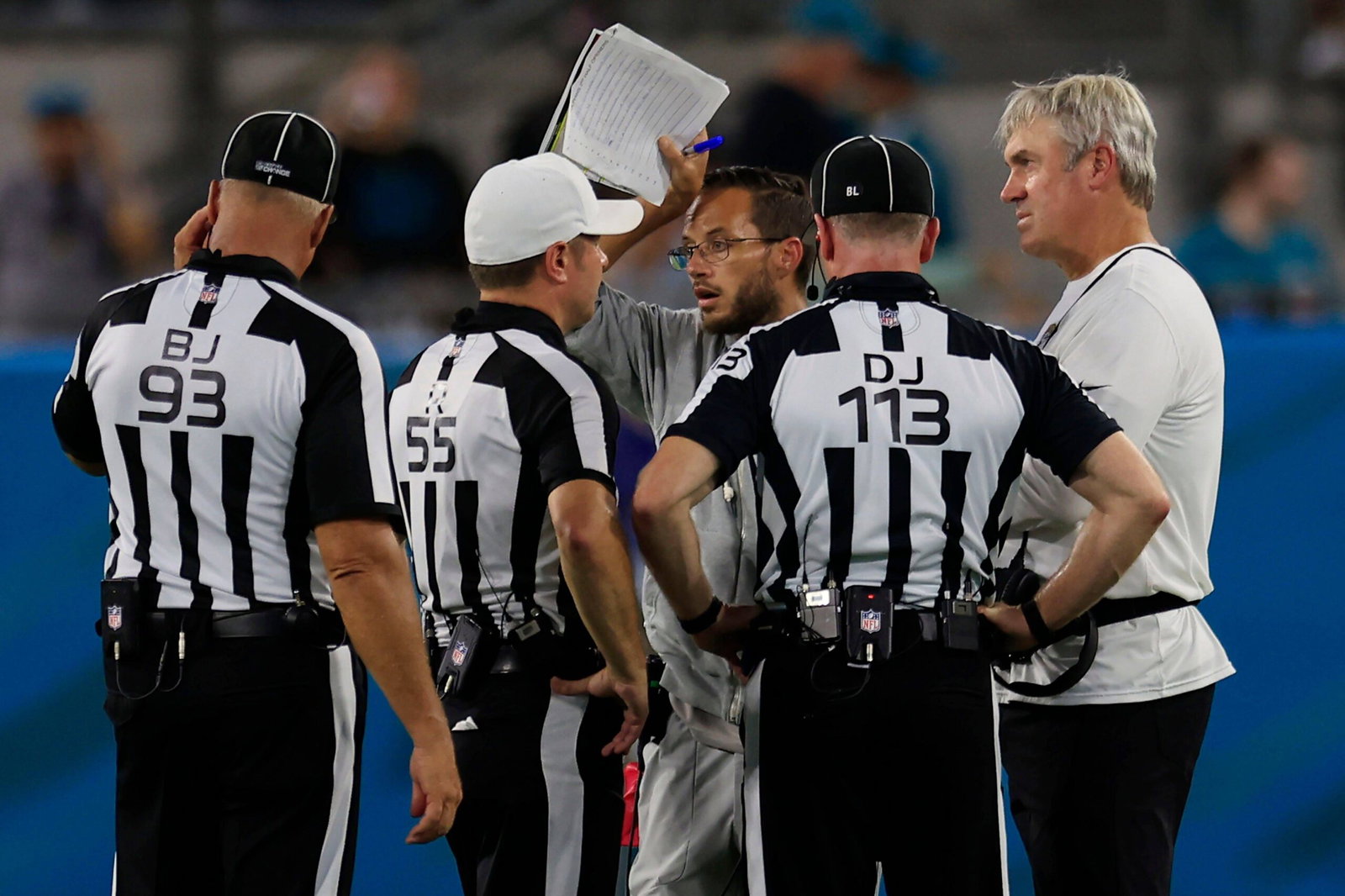
NFL, Miami Dolphins, Daewood Davis Verletzung sorgt für Spielabbruch Syndication: Florida Times-Union Miami Dolphins head coach Mike McDaniel, center, and Jacksonville Jaguars head coach Doug Pederson, right, talk with back judge Scott Helverson 93, referee Alex Kemp 55, and down judge Danny Short 113 to decide suspending the game during the fourth quarter of a preseason matchup Saturday, Aug. 26, 2023 at EverBank Stadium in Jacksonville, Fla. The game was suspended in the fourth after Miami Dolphins wide receiver Daewood Davis 87 was injured on a play with the Jaguars leading 31-18. , EDITORIAL USE ONLY PUBLICATIONxINxGERxSUIxAUTxONLY Copyright: xCoreyxPerrine/FloridaxTimes-Unionx 21286575
NFL, Miami Dolphins, Daewood Davis Verletzung sorgt für Spielabbruch Syndication: Florida Times-Union Miami Dolphins head coach Mike McDaniel, center, and Jacksonville Jaguars head coach Doug Pederson, right, talk with back judge Scott Helverson 93, referee Alex Kemp 55, and down judge Danny Short 113 to decide suspending the game during the fourth quarter of a preseason matchup Saturday, Aug. 26, 2023 at EverBank Stadium in Jacksonville, Fla. The game was suspended in the fourth after Miami Dolphins wide receiver Daewood Davis 87 was injured on a play with the Jaguars leading 31-18. , EDITORIAL USE ONLY PUBLICATIONxINxGERxSUIxAUTxONLY Copyright: xCoreyxPerrine/FloridaxTimes-Unionx 21286575
Nov 17, 2025, 10:41 AM CUT
Every NFL Official Explained: All You Need to Know About Referees, Umpires, and Judges’ Responsibilities
Behind every NFL game’s explosive plays and tense moments stands a team of officials who keep the chaos in check. From the referee making crucial calls to the umpire patrolling the trenches and the sideline judges monitoring every inch of turf, each official plays a critical role in upholding the integrity of the game. Their precision, authority, and split-second decisions shape the outcome just as much as the athletes battling on the gridiron. And here’s the complete breakdown for you.
Referee: The Leader
You’ll spot the referee standing behind the offensive line, about 15 yards back, usually on the right side. The referee is in charge of all the other officials, letting everyone know what fouls just happened and how the game will continue. If you hear a penalty called on the stadium speakers, that’s the referee talking. During each play, the referee watches for things like the quarterback getting hit late or if someone starts moving before the snap. The referee also decides if a tough catch was really a pass or if the ball came loose as a fumble.
When special teams take the field, like for kickoffs and field goals, the referee heads to the goal line of the receiving team. They make sure the right number of players are out there and watch the kicker or holder to catch any sneaky fouls or mistakes.
Umpire: Up Close and Personal
Standing across from the referee, just outside the tight end spot, you’ll find the umpire. This official is responsible for checking that everyone’s safety gear is on before the play even starts. The umpire talks with players to keep the game friendly, counts offensive players, and throws flags for rule violations in the heart of the action (like the center or guards jumping early). If there’s a scramble for the ball on the field, the umpire helps decide who really got it.
Special teams mix things up for the umpire, too. On kickoffs, the umpire makes sure everyone on the kicking team is lined up right and waits for the play to start. During punts, this official stands behind the punter, looking for blocks or fouls. For field goals and extra points, the umpire lines up behind the holder, watching for sketchy plays by the defense.
Down Judge: Sideline Supervisor
The down judge takes charge of the line of scrimmage, working alongside the chain gang that marks where the ball goes and what down it is. They keep the game moving, count offensive players, and watch for sneaky moves like lining up across the line too early or jumping before the snap. If a runner gets shoved out of bounds or there's a close call to mark forward progress, the down judge is the one cheering or shaking their head. The down judge is on goal line duty, counting players and checking for penalties when the play starts.
Field Judge: Deep Defense
The field judge stands 20 yards back on defense, watching the wide receivers and defensive backs. They’re the ones looking to see if anyone’s grabbing jerseys or pushing off. Field judges help call whether passes are caught or whether someone steps out of bounds. If the play is close to the edge of the field, the field judge is right there to make the decision.
During special teams plays, the field judge tracks blocks and stands under the goalposts. Their job is to make sure field goals or extra points are good, no cheating.
Side Judge: Downfield Watcher
The side judge hangs out 25 yards downfield, ready to help if the main timer breaks. They count defensive players, signal the end of quarters, and watch receivers and defenders for grabs or pushes. If someone toes the sideline for a dramatic catch, the side judge helps rule if they’re in or out.
On special teams, the side judge waits near the kick returner and looks out for both legal and illegal blocks. At field goals, this official hangs in the backfield to keep everything fair.
Back Judge: Deep Coverage
Last but not least is the back judge, way back, about 30 yards deep. They count defensive players, keep the play clock running, and make sure TV breaks fit in. On running plays, they watch for holding. During passes, they help judge those tough catches and whether defenders played fair.
When it’s special teams time, the back judge waits on the kicker’s line for kickoffs to check for offside rules, and positions himself behind the returner or under the goalposts for important calls and scoring checks.
Together, these NFL officials make sure that the NFL stays fair and full of big moments. Whether they’re tossing a flag, announcing a penalty, or giving the okay for a touchdown, their teamwork makes every game possible.
Written by

Mrigank Badola